

Putting Behavior Change at the Center of Development and Evaluation
By putting people at the center of the development process, we start to understand why they choose what they do and the constraints they face.
By putting people at the center of the development process, we start to understand why they choose what they do and the constraints they face.
By: Caroline HeiderAnn Elizabeth Flanagan
Acknowledging individuals’ decision-making processes, including implicit and explicit trade-offs, can help introduce measures to address demand-side behavior to complement supply-driven interventions and affect meaningful and lasting change.
Institutions like the World Bank Group work with client countries on interventions that, at their core, aim at changing behavior. Take the provision of health services. The outcome – healthier people – depends not only on sustainable service delivery, but also on the demand for and use of such services, and a change in behaviors that might cause ill-health.
A focus on people affected by interventions, therefore, has to be front-and-center, and even more so when services aim to serve the poor.
Making services available to those without access is important and necessary for poverty eradication. However, to effectively improve the lives of populations that are served, more needs to be done than build the supply-side of services. If we take an infrastructure project like a power plant or school, for example, it is not sufficient that electricity is produced or school buildings are built. Outcomes in the sense of improving people’s lives come about only when these services are accessible, delivered reliably in quantity and quality, are utilized, and lead to changes in behavior.
The 2015 World Development Report on behavioral economics highlights the importance of understanding human behavior in a much more nuanced way than before. Such a perspective has consequences for diagnostic work to understand the diversity of population groups affected by interventions, and for tailoring the World Bank Group interventions to fit local conditions. This would make services more responsive to needs and hence help increase demand for services, and with that the likelihood of changing behaviors in a sustainable manner.
By putting people at the center of the development process, we start to understand why they choose what they do and the constraints they face, including from accessing and using services, or adapting behavior. Acknowledging individuals’ decision-making processes, including implicit and explicit trade-offs, can help introduce measures to address demand-side behavior to complement supply-driven interventions and affect meaningful and lasting change.
To understand better the extent to which behavior change is already built into World Bank Group practices, IEG developed a new framework for Evaluating Behavior Change in International Development Operations. The underpinnings of the framework are rooted in research – both, standard neoclassical economics and behavioral economics – that shows behavior change is dependent on communication; information and incentives; social factors; and psychological factors. Which is why we called the framework CrI2SP.
The framework is designed to help evaluators assess systematically the degree to which projects
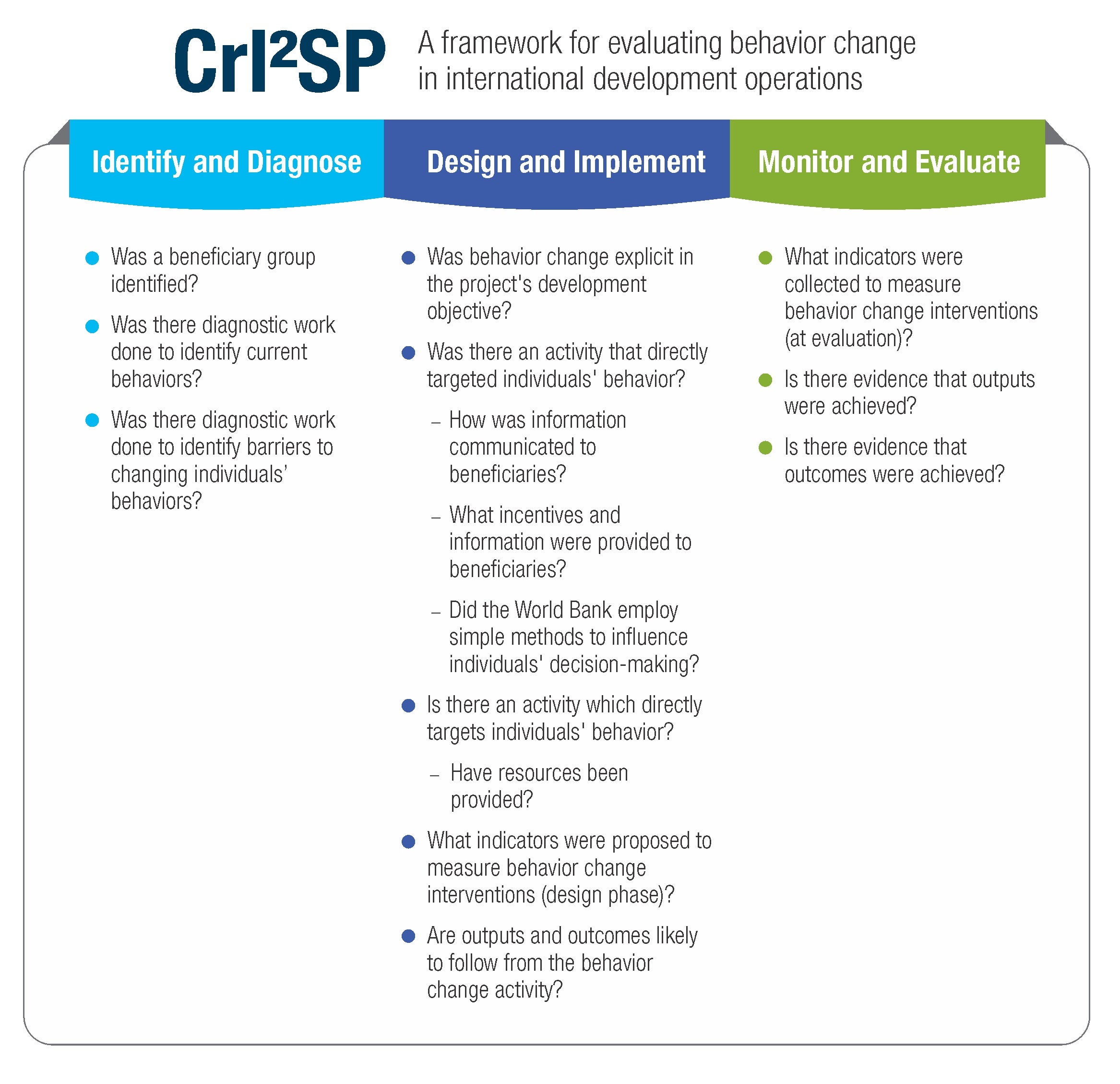
Over the last few months, we have been testing and using this new behavior change framework in our ongoing evaluations, in particular of urban transport, water and sanitation, and health services.
While it’s still early to share the lessons, initial feedback is promising. The first of these evaluations is now nearing completion and will provide us with a first glimpse of how the CrI2SP tool can be used (or needs to be modified) to better capture behavior change in our evaluations. Once the tool works, we will be able to generate insights into these important outcomes of World Bank Group interventions to help colleagues on the operational side of the business design and implement for better outcomes.
Interested in knowing more? Have suggestions or questions? Read the framework and join the conversation by sharing your comments here. We are particularly interested in learning about your experiences incorporating behavior change interventions into project design (and evaluation).








Comments
Thanks for sharing this…
Thanks for sharing this really important and interesting approach. With the actor focus in evaluation shifting between supply and demand side, it seems that the toolkit for assessing behaviroal changes of various actors is getting enriched: tools for measuring behaviroal changes of intermediary actors and that for assessing beneficiary level behaviroal changes. It would be interesting to learn more about operational level indicators used in measuring behaviral changes and how the evaluation data obtained from those indicators get aggregated for utilisation.
Thank you for your very…
Thank you for your very relevant question. Part of what applying IEG’s new framework has highlighted is the need for more and better indicators. In our pilots, indicators for behavior change activities were often missing from results frameworks; when they were in the results framework, they were not monitored or reported at evaluation. We need these data before we can begin to think about even simple comparisons between projects with and without behavior change activities.
I need for information of…
I need for information of this Crl2SP tool
Thank you for your interest…
Thank you for your interest in our new framework. Our working paper provides a great deal of information on the tool along with interesting case studies of its application. http://ieg.worldbankgroup.org/Data/reports/behavior-change-wp.pdf
interesting and useful
interesting and useful
I too commend the initiative…
I too commend the initiative but am concerned that it perpetuates the top-down, externally-led approach to development, rather than the only sustainable approach that requires engagement of target beneficiaries from the outset. (See for example: http://anorthumbrianabroad.blogspot.co.uk/2015/03/foreign-aid-upside-do…). To be a successful agent of change, the change must be one that is totally-embraced. In longtime aid dependent/conditioned countries like Cambodia and Saint Helena, there is often just a shrug of the shoulders as the latest development expert passes through with the latest fad or idea to solve what he or she regards as their problems. You have to be alert to distortion by those you rely upon for coimmunication as often they have theior own agenda, such as securing more income from the likes of you. That distortion is most manifest in indigenous/ethnic minority groups with their own culture and languages (often spoken-only) who are very different from the mainstream faciliators you partner up with in government or enaggage as interlocutors. The fact is they can be as alien as you are. if it is genuine behaviour change you want to cultivate, your framework must put the main players first - not last - in the game. https://www.scribd.com/document/11621086/The-Name-of-the-Game-is-Sustai…
If we want reach ordinary…
If we want reach ordinary people to play a central role their behavioural change the World Bank and similar institutions have to learn to use a common language and not Bankees. I have 40 years in the international sanitation sector. I have worked with the World Bank in the Technology Advisory Group (TAG) in the 1980s . We identified the World Bank semi-secret language as a major bottleneck, not the technology. The solution is easy but obviously difficult to penetrate to the level of the influential (?) people. For technology and communication we need it so be stupidly simple. KISS
Good that you shared. It is…
Good that you shared. It is a typical WB pattern including the terms used in the paper.
Add new comment